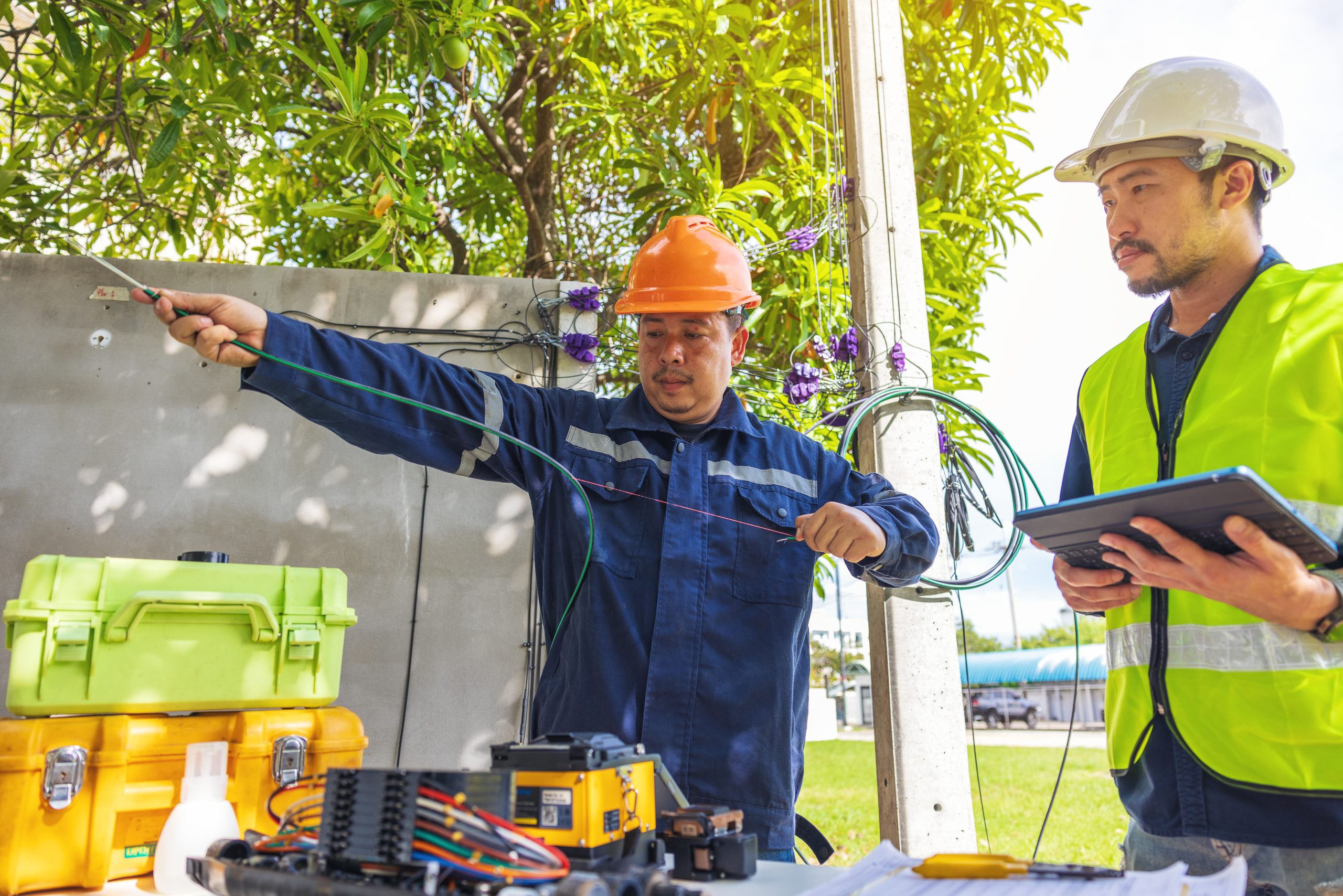
Engaging the right ELV contractor Malaysia determines whether your building’s surveillance, access control, communications, and automation systems function as an integrated security and operational platform — or as a collection of disconnected components that require multiple vendors for every service call. Extra Low Voltage (ELV) systems have become the nervous system of modern Malaysian commercial and industrial buildings: a 2024 study by CIDB Malaysia found that ELV systems (CCTV, access control, structured cabling, PA, and BAS) now represent 12 to 18% of total building construction cost on commercial projects in Malaysia. This guide explains the top benefits of engaging a qualified ELV contractor in Malaysia, what ELV systems encompass, and how RISB’s integrated approach delivers better outcomes than the multiple-vendor alternative.
What Is an ELV Contractor in Malaysia?
An ELV (Extra Low Voltage) contractor in Malaysia is a specialist systems integrator who designs, supplies, installs, tests, commissions, and maintains all electronic building systems operating below 50V AC or 120V DC — collectively known as ELV or “weak current” systems. In Malaysia, ELV systems are distinct from M&E (Mechanical and Electrical) systems that handle mains power (240V/415V) — ELV contractors carry the electronic engineering capability to programme, configure, and integrate smart building systems that M&E contractors do not typically possess.
According to the Construction Industry Development Board (CIDB) Malaysia , over 2,800 contractors hold specialist ELV systems registration in Malaysia, but only 340 are registered at Grade G4 or above — indicating sufficient technical and financial capacity for large-scale commercial and government projects. RISB (Radical Internetwork Sdn Bhd) holds CIDB Grade G7 registration — the highest available grade — and has delivered ELV systems for data centres, hospitals, government facilities, and commercial buildings across Penang, Kedah, and the Klang Valley since 2003.
ELV Systems — What Does an ELV Contractor in Malaysia Install?
| ELV System | What It Does | Typical Application |
| IP CCTV / Video Surveillance | Continuous recording and monitoring of all building zones | Perimeter, lobbies, carparks, server rooms |
| Access Control | Card, biometric, or facial recognition entry management | Building entrances, restricted areas, data centres |
| Public Address (PA) System | Building-wide communication, emergency announcements, background music | Offices, factories, hospitals, shopping malls |
| Structured Cabling (Cat6/6A/Fibre) | Physical network and voice cabling infrastructure | All buildings with network connectivity requirements |
| Building Automation System (BAS/BMS) | Centralised monitoring and control of HVAC, lighting, energy, and security systems | Large commercial buildings, data centres, hospitals |
| Intrusion Detection / Alarm | Motion detection, door/window sensors, alarm monitoring | Commercial offices, industrial facilities |
| Audio-Visual (AV) Systems | Meeting room AV, digital signage, video conferencing | Corporate offices, training centres, hotels |
| Video Intercom / Door Entry | Remote visual verification for visitor access | Residential, corporate, healthcare |
| Nurse Call System | Patient-to-nurse communication and emergency response | Hospitals, clinics, aged care facilities |
Benefit 1: Single-Contractor Accountability for All ELV Systems
The most quantifiable benefit of engaging a single full-service ELV contractor in Malaysia is the elimination of the coordination overhead, gap risk, and blame-avoidance that characterises multi-vendor ELV installations. When a building’s CCTV is installed by Vendor A, structured cabling by Vendor B, access control by Vendor C, and PA by Vendor D — and the system doesn’t work on day one — every vendor blames another vendor’s work as the root cause. Resolution requires the building owner to manage a multi-party dispute rather than receiving a single point of accountability.
RISB provides single-contractor accountability for all ELV systems from design through commissioning and handover. Every system in the scope — cabling, CCTV, access control, PA, BAS — is designed, installed, tested, and commissioned by RISB’s own team. If a system does not perform to specification at acceptance testing, RISB’s obligation is unambiguous: we rectify it. No multi-vendor blame cycle, no gap in accountability.
Benefit 2: Integrated System Design — Better Security and Operational Outcomes
An ELV contractor who designs all building systems simultaneously achieves integration outcomes that are impossible when each system is designed and installed independently. Integrated ELV design means:
· Access control linked to CCTV — when an access control event occurs (door forced open, after-hours access, invalid credential attempt), the system automatically retrieves the CCTV footage from that door’s camera for the 30 seconds before and after the event. An access control event without supporting CCTV footage provides half the information a security team needs.
· PA linked to access control and BAS — an emergency evacuation triggered by the fire alarm system automatically switches the PA to emergency announcement mode across the entire building, overriding background music and meeting room audio simultaneously. This integration requires all three systems to be specified and configured together.
· Structured cabling designed for all ELV systems — IP cameras, access control readers, PA controllers, and BAS sensors all use the building’s cabling infrastructure. A cabling system designed without knowledge of the IP camera count and locations, access control topology, and BAS sensor points will require additional cabling runs — adding cost and disruption after occupation.
Benefit 3: BOMBA and Regulatory Compliance Built-In
Malaysian buildings require BOMBA (Fire and Rescue Department Malaysia) approval for fire alarm and PA systems as a prerequisite for Certificate of Completion and Compliance (CCC) — and BOMBA compliance is an ELV contractor’s direct responsibility, not the main contractor’s. BOMBA requires:
· Fire alarm systems compliant with MS 1176 (Malaysian Standard for Fire Detection and Alarm Systems)
· PA systems integrated with the fire alarm for emergency announcement capability (BOMBA-approved PA is mandatory for buildings above 3 storeys)
· As-built ELV drawings submitted to BOMBA for approval before occupation
· Test certificates issued by the contractor for all fire safety ELV systems
RISB prepares and submits all BOMBA documentation and coordinates the BOMBA inspection as part of the standard ELV contractor scope. Building owners who engage separate vendors for fire alarm and PA frequently encounter BOMBA approval delays caused by documentation gaps or system integration failures between the two vendors.
Benefit 4: Structured Cabling as the Foundation for Future Scalability
Structured cabling — the physical network of Cat6/Cat6A copper cables and multimode/singlemode fibre that connects every active ELV device to the network — is the most important long-term infrastructure decision in any building ELV project. A correctly specified, properly installed, and tested cabling system will support the building’s IT, security, and automation needs for 15 to 20 years. A poorly specified or improperly installed cabling system will require partial or full replacement within 5 years as network speeds increase or devices are upgraded.
RISB specifies and installs structured cabling to TIA-568 and ISO/IEC 11801 standards with full channel certification testing using Fluke DSX series cable analysers. Every link in the structured cabling system is tested to Category performance specification and a test report is provided with handover documentation — so the building owner has independent verification that the cabling system delivers the promised performance.
Benefit 5: Reduced Long-Term Maintenance Cost
An ELV contractor who designed and installed all the building’s ELV systems provides the most cost-effective ongoing maintenance — because they hold the design drawings, system configuration backups, and commissioning records that any other contractor would need to request or recreate before performing maintenance.
RISB’s maintenance service for installed ELV systems includes: quarterly preventive maintenance visits, 24-hour emergency response SLA, software and firmware update management, annual system certification, and end-of-life equipment planning. Malaysian building facilities managers consistently report that multi-vendor ELV maintenance costs 25 to 40% more than single-contractor maintenance — because each vendor charges a minimum visit fee and requires mobilisation time regardless of how minor the issue is.
Benefit 6: ELV + M&E Integration from a CIDB G7 Contractor
RISB’s unique capability in the Malaysian ELV contractor market is the combination of CIDB G7 M&E contracting and full ELV systems integration under a single entity — enabling seamless coordination between high-voltage M&E work (power distribution, HVAC, lighting) and low-voltage ELV systems (CCTV, access, PA, cabling) that are designed and executed by the same team.
Most Malaysian buildings require both M&E and ELV scope on construction projects. When these are split between two separate contractors — as is common — coordination gaps cause delays: M&E contractors leave conduit provisions in the wrong locations for ELV cable runs; ELV contractors find the power supply positions for IP cameras and access control panels don’t match their design. RISB eliminates this coordination gap by executing both scopes internally.
Multi-Vendor vs Single ELV Contractor — Cost Comparison
| Cost Factor | Multi-Vendor Approach | Single ELV Contractor (RISB) |
| Design coordination | Multiple design meetings, drawings, and revision cycles | Single integrated design process |
| Installation supervision | Client must coordinate multiple site access requests | Single point of contact and schedule |
| Interface testing | Each vendor tests own system; integration failures require multi-party resolution | RISB tests full integrated system performance |
| BOMBA documentation | Fire alarm and PA vendor may each submit separately — risk of inconsistency | Single BOMBA submission covering all ELV systems |
| Maintenance cost | Separate call-out fees per vendor (typically 4–6 vendors) | Single maintenance contract, one call-out fee |
| System upgrade | Requires all relevant vendors to coordinate — high coordination cost | Single upgrade decision, single implementation |
| Total 5-year cost premium | +25–40% vs single contractor | Baseline |
How to Choose an ELV Contractor in Malaysia
These five criteria separate a capable ELV contractor from one whose systems will underperform, fail prematurely, or create compliance problems.
· CIDB Grade G4 or above — minimum G4 for commercial projects with contracts above RM 500,000. G7 for government and large-scale industrial projects. Verify registration on CIDB’s online contractor lookup.
· Track record in your building type — a contractor with 20 data centre projects understands the DCIM integration, redundancy, and security requirements of that environment. A contractor whose portfolio is residential condominiums may lack the technical depth for a mission-critical data centre ELV scope.
· In-house engineering team — verify that the contractor has employed engineers (not subcontracted labour) for design and commissioning. An ELV contractor who subcontracts all installation work has limited accountability for quality and no institutional knowledge of your system after handover.
· Brand-agnostic vs brand-tied specification — a good ELV contractor specifies the system that best meets your requirements and budget, not the brand they hold exclusive distributorship for. RISB holds relationships with all major ELV system brands and specifies based on project requirements.
· Post-installation maintenance capability and track record — an ELV contractor who disappears after practical completion is a significant risk. Verify that the contractor provides documented maintenance services with SLAs, has a dedicated service team separate from the project team, and can provide references from active maintenance contracts.
Key Takeaways
· ELV contractor Malaysia scope covers CCTV, access control, PA, structured cabling, BAS, intrusion detection, AV, video intercom, and nurse call systems — the electronic nervous system of every modern Malaysian commercial building.
· Single-contractor ELV delivery eliminates the coordination overhead, gap risk, and multi-vendor blame cycles that cost building owners time and money on every project.
· Integrated ELV system design — access control linked to CCTV, PA linked to fire alarm — delivers security and operational outcomes impossible when each system is specified independently.
· BOMBA-compliant fire alarm and PA system installation and documentation is an ELV contractor’s direct responsibility — not the main contractor’s. RISB manages all BOMBA submissions and inspections.
· Multi-vendor ELV maintenance costs 25–40% more than single-contractor maintenance over a 5-year period.
· RISB holds CIDB G7 registration with combined M&E and ELV capability — eliminating the M&E/ELV coordination gap that delays most Malaysian building projects. Active project presence across Penang, Kedah, Selangor, and Kuala Lumpur.
Frequently Asked Questions — ELV Contractor Malaysia
What is an ELV contractor in Malaysia?
A specialist systems integrator who designs, installs, and maintains Extra Low Voltage building systems — CCTV, access control, public address, structured cabling, building automation, and security systems — operating below 50V AC. ELV contractors hold CIDB registration and work alongside M&E contractors on commercial, industrial, and government building projects in Malaysia.
What is the difference between M&E contractor and ELV contractor?
M&E contractors handle high-voltage systems — mains power, HVAC, fire protection, plumbing (240V/415V). ELV contractors handle low-voltage electronic systems — CCTV, access control, PA, cabling (below 50V AC). RISB holds CIDB G7 registration for both scopes, enabling single-contractor delivery of M&E and ELV on complex building projects.
Do I need an ELV contractor for my building in Malaysia?
Yes — commercial and industrial buildings in Malaysia require BOMBA-approved fire alarm and PA systems, structured cabling for network infrastructure, and access control and CCTV for security compliance. A qualified ELV contractor designs and certifies these systems for CCC (Certificate of Completion and Compliance) purposes. RISB provides ELV contractor services across Penang, Kedah, Selangor, and KL.
What ELV systems does RISB install in Malaysia?
IP CCTV and video surveillance, access control (card, biometric, facial recognition), public address and background music, audio-visual and digital signage, structured cabling (Cat6, Cat6A, fibre optic), building automation systems, intrusion detection, video intercom, and nurse call systems. Full design, supply, installation, testing, commissioning, and maintenance services. View RISB’s full ELV services.
How do I choose an ELV contractor in Malaysia?
Verify CIDB registration (G4 minimum, G7 for large projects), check project track record in your building type, confirm in-house engineering team (not subcontracted), assess brand-agnostic specification approach, and verify post-installation maintenance capability with active SLA contracts. RISB meets all five criteria with CIDB G7 registration and 20+ years of ELV delivery across Northern Malaysia and Klang Valley. Request an ELV project consultation.